• Be Strong With Emphasis: Semantics

    There are advantages of using <strong> over <b>, and <em> (as in emphasis) over <i>. I’ll try to explain the differences of these semantics as simply as possible.

    In HTML, <b> tells the browser to display type as bold, and <i> tells the browser to display type in italics. The problem with this is that these terms are only applicable to visual display, and become problematic when you are trying to make your site compatible for accessibility devices.

    Enter <strong> and <em>. While in a browser display they might look no different to their <b> and <i> counterparts, they can semantically have meaning for accessibility devices such as screen readers, and can be rendered accordingly for the device a website visitor is using.

    There are additional arguments also about separating style from the document structure. This is called Semantic HTML. In this case, bold and italic styles should be contained within the CSS of your site, rather than in the HTML using <b> and <i> tags. What’s interesting about this is that <strong> and <em> does not have to mean “make bold” or “make italic” if you decide to redefine it’s style to simply a change of color.

  • The Flexibility of Cycling

    One of the amazing things about cycling, I think, it ‘s flexibility. There aren’t many modes of transportation that let you transition from operating a vehicle to being a pedestrian almost seamlessly. With this flexibility, it’s important to remember that automotive transportation is NOT flexible. It’s awkward, cumbersome, and clumsy.

    To navigate safely with automotive traffic, it’s helpful to behave as they do per the Highway Traffic Act. Doing so makes you predictable, and reduces unnecessary risk on the street. And don’t forget to take advantage of transitioning to “pedestrian mode”, where possible, if traffic gets a little to thick for your liking.


  • A Beautiful Snowfall In Brampton

    Just thought I would post one for viewing pleasure. 🙂 Enjoy!


  • Passing Safely

    A few days ago, this happened:


    Not the brightest move, granted. My camera didn’t capture the license plate, so there’s little to report to the police I’m afraid. I want to mention that although the driver’s manoeuvre was reckless, I didn’t feel like I was in immediate danger. I did my part, slowed down and moved over to facilitate a pass as quickly as I could once I was aware of it.

    There are a few things about this video I find interesting and wanted to talk more about in detail:

    • Notice that there is a solid line in the middle of the roadway. Passing in this zone was not a good idea. The reason for that is because;
    • The road curves down around a hill and narrows over a bridge. The road was a little wet, and I don’t know if the driver could see around me or not. Assuming not because of how close they came to oncoming traffic. If that’s the case, why put yourself at risk? Was it that important to pass a cyclist?
    • My favourite: The lead car of oncoming traffic was none other than a unit of the Peel Regional Police force (pause around 3-5 seconds to see for yourself) so I definitely want their opinion of this clip. 😉

    One question I have is: Could this pass have been cited for dangerous driving? Drivers and cyclists (and Peel Police), what are your thoughts?

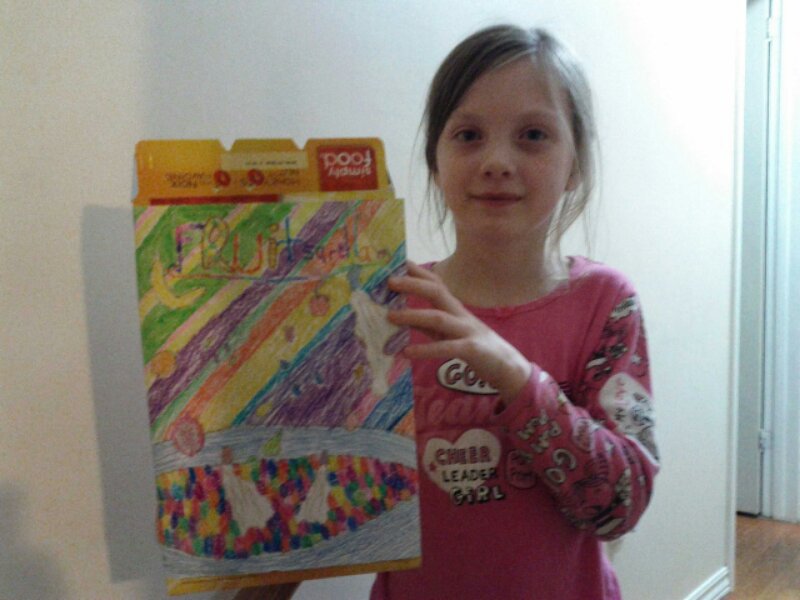
  • 8YO designs her first cereal box. 🙂

    image

  • Taking The Lane in #biketo

    This is my first stab at opening a dialogue. It’s a video of a typical morning commute through downtown Toronto. I’ve posted annotations of sections from the Highway Traffic Act in the video that I think apply to the things I’m doing in the video. But it also shows some advantages to “taking the lane”, and asks questions, such as:

    • What does taking “”share the road, not the lane” mean? And what does it look like?
    • When making a left turn, are we to exit the intersection in the left-hand lane, or turn in to the outer lane provided for us?

    Have a watch and enjoy. I look forward to chatting about it on #biketo.


  • #Brampton Morning Commute – A.K.A. – “Space Mountain”

    The first video I want to post is one of my favorite parts of my commute in the Winter, when the sun hasn’t come up yet.


  • My 6YO was organizing while I was out. #biketo

    image

  • An Idea for #biketo: A Dialogue, With Video

    I recently got a GoPro Hero2 camera with a head strap mount up and running, and have started documenting my bike journeys. More than just contributing fodder to “blame and shame”, what I want to do is start a dialogue. I want to share my tips, and my experiences living carless with a family. I also want to get tips back from cyclists, drivers, and pedestrians alike, about what we can do to improve the safety of our streets in different urban and suburban situations.

    With that in mind, I’m starting a YouTube channel where I’ll start posting some of my videos. I have some examples captured of things to watch for, to get a discussion started. They’ll be posted (hopefully) within a few days.

    In the meantime: If you’re curious about what you can do to reduce your reliance on a car, riding in different weather, or anything else related to a carless lifestyle, feel free to drop me a line. I’ll do the best I can to answer by video. 😉

  • The Maiden Voyage of a Cargo Bike

    In November of 2012, I purchased a Babboe City Cargo Bike from Curbside Cycle, at their incredible “Black Saturday” price. We (my family and I) were now 7 months into our car-free lifestyle, and decided to get ourselves an early Christmas present. This post is a recount of picking up the bicycle, taking it home, and thoughts on things I observed along the way.

    Curbside Cycle

    There are many quality bike shops in Toronto: MEC and Urbane Cyclist to name a few. These shops have a variety of bikes to choose from to suit your needs. Curbside however, seems to focus specifically on European imported items, made from solid materials, and are easy on the eye. I think that if you plan on picking up quality gear that you will ride with year-round and don’t want too much hassle with maintenance, then Curbside is the place to go.

    There were a few things I had to accept before paying for the bike, and ultimately come to terms with after paying for it.

    1. The Babboe City is big.
    2. The Babboe City is heavy.
    3. Because of the first two points, the bike would not fit on a bus, or a train.
    4. See point 1.

    While some in their right mind might have decided to rent a truck, load up the bike, and take it home, I am clearly not one of those people. I decided that I had 3 hours or so to kill, and rode the bike home to Brampton, from Curbside which is roughly near Bloor and Spadina in Toronto.
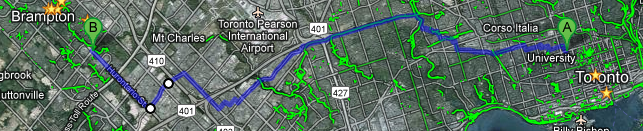
    Map: An overview of the route I biked home

    The first thing I noticed is that riding a cargo bike is a lot like driving a truck. It takes a while to accelerate, it takes a while to slow down, and you don’t corner very well. Once you get used to it though, it’s just fine. The next thing I noticed is that riding a large cargo bike in midtown traffic is not that bad. It helps to follow the basic rules of course: Signal, leave space, make yourself visible, etc. Of course, it’s hard to stay hidden riding a bicycle of this size! But, in the entire trip, midtown felt the safest. More on that later.

    The First Leg: Getting To Dupont
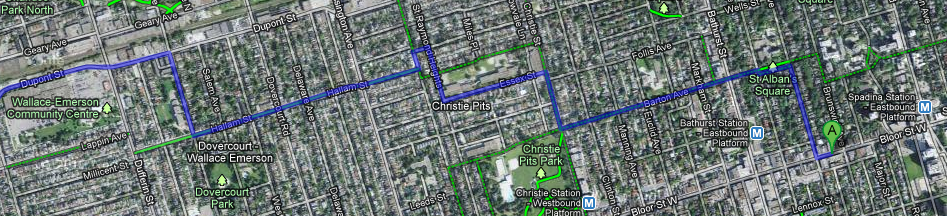
    Map: Trip To Dupont

    I used the bicycle navigation feature on my Android phone to help me stay on track. But with this decision came to realizations as I approached Hallam St. 1: Having a phone tucked safely in my pocket makes the GPS lock, shall we say, “fuzzy”. 2.  My phone would suddenly “realize” where I was, and it was then I learned the ability to respond suddenly on a cargo bike is somewhat limited. As is the ability to turn around without a 3-point turn. It’s might be better to take this bike on routes you’re comfortable with.

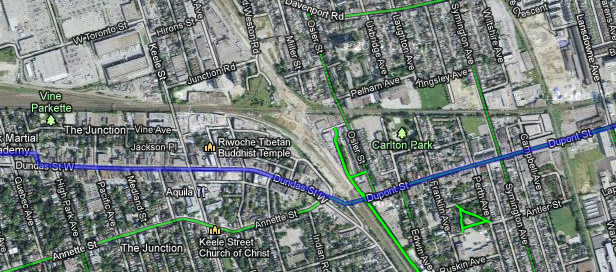
    Dupont To Dundas

    TEst Map-DupontToDundas

    The next thing I learned is that people seem to display a certain amount of forgiveness when you’re riding a cargo bike on the street. There seems to be an implicit understanding that it’s not the kind of vehicle you would want to see whipping around on the sidewalks at 25+ KM/h. I had no problems with sharing the outer lane between Dufferin and Lansdowne.

    Then, I noticed something wonderful: Dupont’s got bike lanes! This was my first time riding them. I’m thankful in a way that this was not a busy night, because the width of the cargo bike pretty much filled up the width of the lane. I took the Dupont bike lanes west to where they end at the Dundas junction. Once on Dundas, I was back to sharing the lane. Again, I experienced no difficulties.

    Dundas To Scarlett
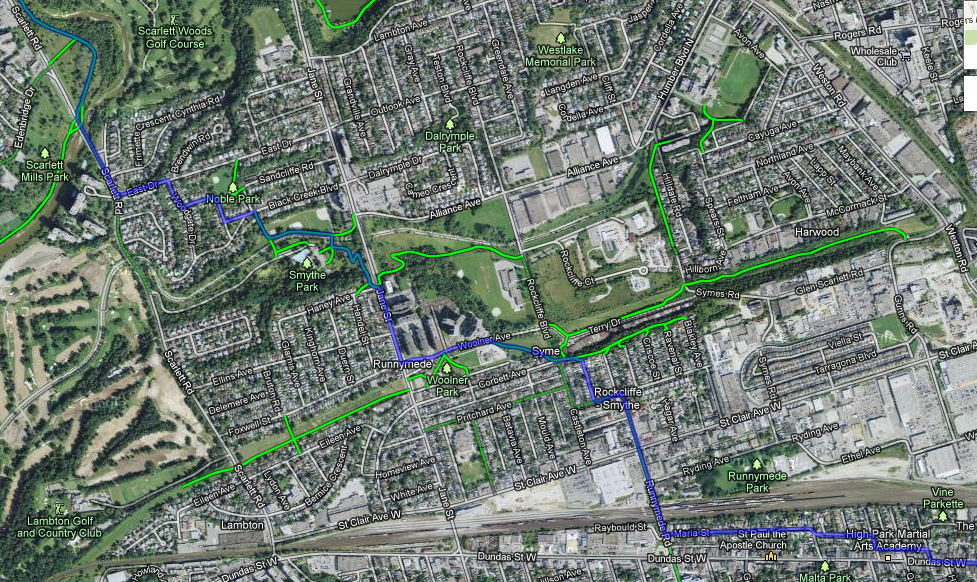
    Map-DundasToScarlett

    Wow. It was a good thing that I had a quick crash course on maneuvering the cargo bike, because this stretch required some serious attention. By now it was starting to get visibly foggy out, especially as I got to Jane Street. The road and path went through a series of ascents and descents, which had some very interesting fog formations to ride through. I had a secondary CatEye headlight connected to point ahead, while the on-board headlight of the cargo bike was pointed down on the ground to illuminate any obstacles I might not otherwise see.I’m glad I did that, because what I didn’t know was how poorly lit the paths would be from here on.

    Scarlett To Eglinton
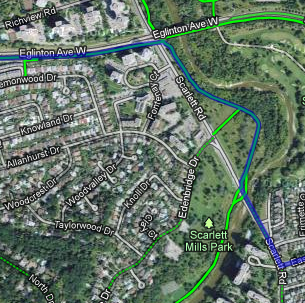
    Map-ScarlettToEglinton


    Scarlett was a quick and pleasant ride. It took me straight to Eglinton, where I found another pleasant surprise: A separated lane!

    Eglinton To Matheson
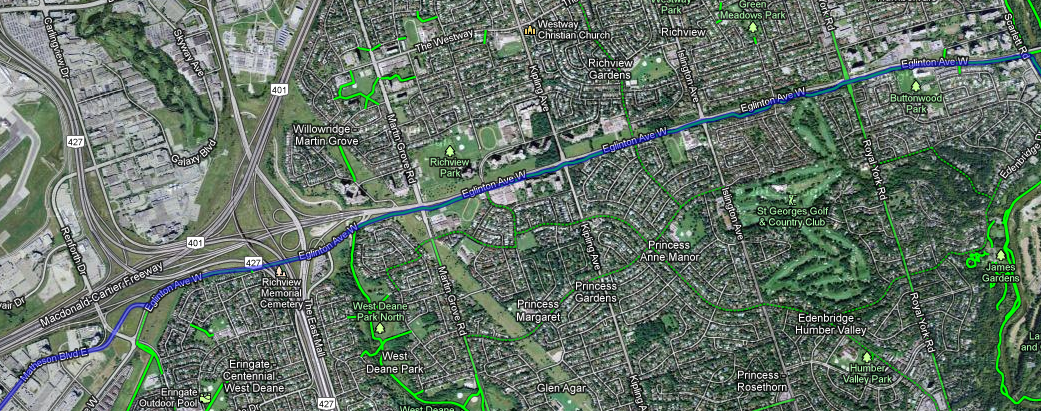
    Map-EglintonToMatheson


    There are 2 things to note about this stretch of my trip:

    1. Separated lanes are awesome.
    2. While awesome, I noticed a marked change in driver’s temperament along this stretch at intersections. Much more aggressive, and very little regard for right of way. I had to stop mid-intersection twice to not hit a car that didn’t slow down to make a right turn after I had started to cross.

    At around the 427, the separated lane terminates and I had to rejoin traffic in a shared outer lane. Whereas downtown traffic wasn’t a problem, this area was a different story. There is a serious lack of regard for cyclists sharing the lane here, with no less than 4 vehicles overtaking me without changing lanes properly, needlessly coming very close to me. Interestingly, this attitude reverted back to some semblance of sensibility once I got to Matheson.

    Matheson To Tomken
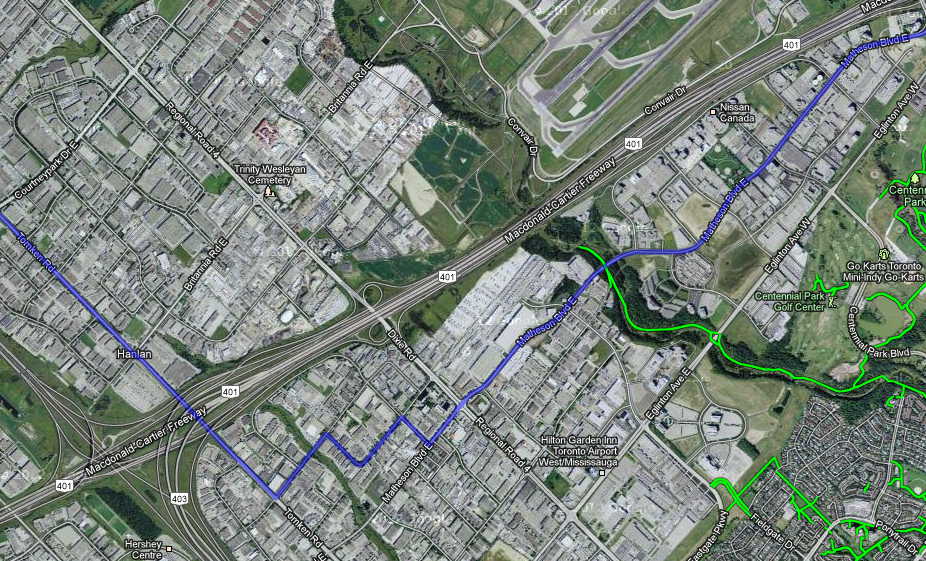
    Map-MathesonToTomken


    I was starting to feel a little thirsty. Besides that, this section of the trip, and the sections to follow, were largely uneventful, which was fine with me. I’ll breeze through the rest quickly.

    Tomken To Courtneypark
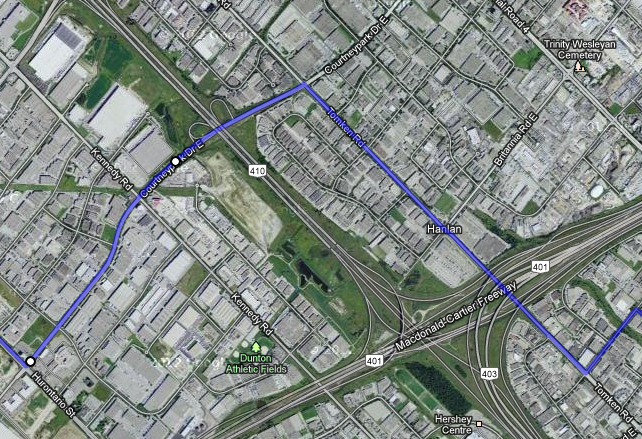
    Map-TomkenToCourtneypark

    I stopped at Courtneypark and Kennedy at a Tim Hortons for a water and coffee. I went through the drive-through and parked the bike in a parking spot. It was fun!

    Courtneypark To Hurontario, Then Home
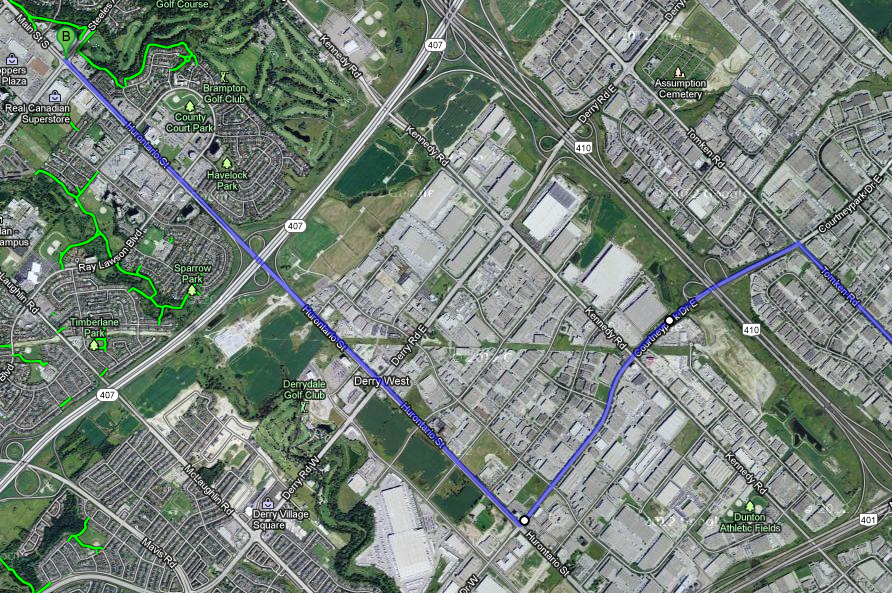
    Map-CourtneyparkToHurontario-Home

    In all, the trip home took about 3 hours. This included a 30 minute stop at Tim Hortons, and about a 30 minute run or so at the Superstore at Hurontario and Steeles.

    That pretty much wraps up this trip. If you have any questions about the cargo bike, what it’s like to ride it, etc. Drop me a line!